Tag: body

  • How Do I Know This Life Is Real?

    Some lives produce a great deal of evidence.

    Photographs.

    Announcements.

    Promotions.

    Relationships.

    Trips.

    Milestones.

    Stories.

    The evidence accumulates naturally. A person can point to what happened and where they were when it happened. Others can confirm it. The life enters the record.

    Other lives are harder to verify.

    A friendship deepens.

    A prayer becomes habitual.

    A boundary is held.

    A nervous system regulates.

    Attention changes.

    Desire fades.

    This evidence is difficult to photograph.

    No obvious event marks the transition. Nothing appears to happen. Yet something has happened.

    A great deal of modern life is organized around evidence. Not because people are shallow. Because evidence is reassuring.

    It answers questions.

    Am I moving forward?

    Am I loved?

    Am I interesting?

    Am I succeeding?

    Am I becoming someone?

    Evidence reduces uncertainty. It provides proof that life is occurring. The difficulty is that evidence and reality are not the same thing.

    Some changes are easy to explain.

    A glow-up.

    A move.

    A new relationship.

    These changes come with something to report. They can be photographed, announced, measured, introduced, or described.

    Other changes are harder to explain.

    Trust.

    Discernment.

    Forgiveness.

    Friendship.

    Wisdom.

    Patience.

    Self-respect.

    The enjoyment of solitude.

    These changes may alter the whole structure of a life, but they do not always give a person a clean update to offer when someone asks what is new.

    This is where the confusion begins.

    The easiest changes to explain can start to feel like the most important ones.

    A packed calendar can look like progress.

    Dinner reservations, flight confirmations, weekend plans, and group photos can make a life appear to be moving.

    Recognition can look like confirmation that the life is on the right track.

    Compliments.

    Invitations.

    Congratulations.

    “You seem so happy.”

    The response can become more persuasive than the actual condition of the life.

    However, many of the most consequential changes produce very little evidence while they are happening.

    They do not announce themselves.

    They do not arrive with witnesses.

    They often become visible later, through what a person is now able to do.

    The ability to remain present produces little documentation.

    So does telling the truth.

    So does resisting compulsion.

    So does staying when running would be easier.

    A person learns not to send the text.

    A person learns not to explain themselves.

    A person learns to leave when staying would require self betrayal.

    A person does not become discerning on the day they walk away from the wrong relationship.

    The discernment was forming months or years earlier.

    The breakup is simply the visible consequence.

    A person does not become patient on the day they remain calm during an argument.

    The patience was formed long before it was required.

    The argument merely revealed it.

    A person does not become a friend on the day they sit beside someone in silence.

    The friendship was built elsewhere.

    The silence simply makes it visible.

    What appears sudden from the outside is often the result of a long invisible process.

    The visible event is not always the change.

    Often, it is the first piece of evidence that the change has already occurred.

    This creates a peculiar problem.

    When a life becomes quieter, slower, less performative, and less visible, the usual forms of proof begin to disappear.

    There are fewer stories to tell.

    Fewer updates to give.

    Fewer milestones to report.

    The question arrives almost automatically:

    Is anything actually happening?

    The question sounds practical.

    It is actually perceptual.

    What forms of change do I recognize, and which ones do I overlook because they leave no record?

    The inner life is often asked to prove itself using measures it does not naturally produce.

    It may not offer a milestone.

    It may not create a story.

    It may not produce a visible achievement.

    Sometimes it appears only as less.

    Less noise.

    Less urgency.

    Less performance.

    Less need to demonstrate.

    Less reaching for what no longer has authority.

    The reduction can be mistaken for stagnation.

    The quiet can be mistaken for absence or dullness.

    The ordinary can be mistaken for mediocrity.

    The absence of evidence can be mistaken for the absence of change.

    But scarcity of evidence and scarcity of reality are not the same condition.

    A life may be heavily documented and lightly inhabited.

    A life may be lightly documented and deeply inhabited.


    What forms of change do you recognize, and which ones do you overlook because they leave no record?

    A canoe trip. Algonquin Park, sunset.
  • The Illusion of Repair

    For a long time, I believed communication could solve nearly anything.

    If two people cared enough, tried hard enough, and spoke honestly enough, reality would eventually emerge.

    A misunderstanding could be clarified. A conflict could be resolved. A relationship could be repaired.

    And sometimes that is true.

    But over time, I noticed a pattern. Certain conversations seemed to produce less clarity, not more. The more words were exchanged, the harder reality became to see.

    At first, this broke a pattern in me. I was a firm believer that communication was supposed to bring people closer to the truth.

    What I slowly discovered was that communication serves many purposes.

    It can reveal reality. It can also preserve an image.

    Communication assumes both people are in reality.

    When one person is unwilling or unable to see what is happening, more communication does not create truth.

    It often creates distance from truth. Not because anyone is necessarily lying. Not because anyone is necessarily malicious.

    But because image management and truth-seeking are often competing activities.

    Some conversations are attempts to understand what is true. Others are attempts to protect a version of oneself.

    The difference matters.

    At first, this was difficult for me to accept. It felt responsible to keep explaining. It felt mature to keep trying. It felt compassionate to keep giving reality another chance to become visible. The more I paid attention, the more often I found the same instinct in myself.

    But eventually I began to notice the cost.

    Communication can become a way of postponing action. A way of extending ambiguity. A way of negotiating with something that has already become clear.

    The conversation continues. The pattern remains. The explanation improves.

    Reality does not change.

    What I once called patience was sometimes hesitation. What I once called communication was sometimes avoidance. Not avoidance of another person. Avoidance of what I already knew.

    The most painful truths in my life rarely arrived all at once.

    They arrived slowly.

    As patterns.

    As repetitions.

    As things my body noticed before my mind agreed.

    The temptation was always the same: One more conversation. One more explanation. One more attempt to make reality visible. What I discovered was that reality does not require agreement in order to be real.

    It only requires recognition.

    And once reality has been recognized, communication is no longer the primary strategy.

    Orientation is.

    Not:

    “How do I explain this?”

    But:

    “What am I going to do now that I see it?”


    Where are you using communication to avoid acting on what you already know?

  • The Body Knew First

    For a long time, I thought good decisions came from thinking harder.

    Gather more information. Analyze the situation. Consider every angle. Wait for certainty.

    Looking back, I noticed something unsettling.

    My body often knew long before I was willing to admit it.

    A tightening jaw, a held breath, an unease I couldn’t explain, a quiet no.

    For years, I had a simple explanation for these reactions.

    Anxiety.

    That explanation was convenient because it kept the focus on me. If the feeling was anxiety, then the problem was my interpretation, my fear, my sensitivity, my wounds.

    I didn’t have to ask whether the feeling might be responding to something real.

    What I rarely considered was that my body might be witnessing something my conscious mind was not yet ready to admit.

    Again and again, I treated these signals as obstacles to overcome rather than information to consider.

    I trusted explanations more than sensations, stories more than signals, and hope more than reality.

    I assumed the signal was a cue to gather more data. To wait, investigate further, withhold judgment until more evidence arrived.

    Sometimes that is wise.

    But looking back, I can see that I often misunderstood the nature of the signal itself. The signal was not pointing toward the data. The signal was the data.

    The tightening fist. The shifting in my balance. The sense of alarm. The difficult no.

    These were not distractions from reality. They were reality arriving through a different channel.

    Not conclusions, nor certainty. But rather, information. And information I repeatedly ignored.

    Part of the work of Secret Places became learning to stop arguing with those signals.

    Not because the body is God, not because every feeling is true, and not because intuition is infallible.

    But because my body had been recording reality long before I had language for what it was witnessing.

    The body was not the authority. But it was a witness.

    And often it arrived first.

    Many of the things I eventually admitted intellectually had already been registered physically.

    My body knew before I did.

    Listening wasn’t the hard part. The hard part was obeying.


    What truth might your body already know?

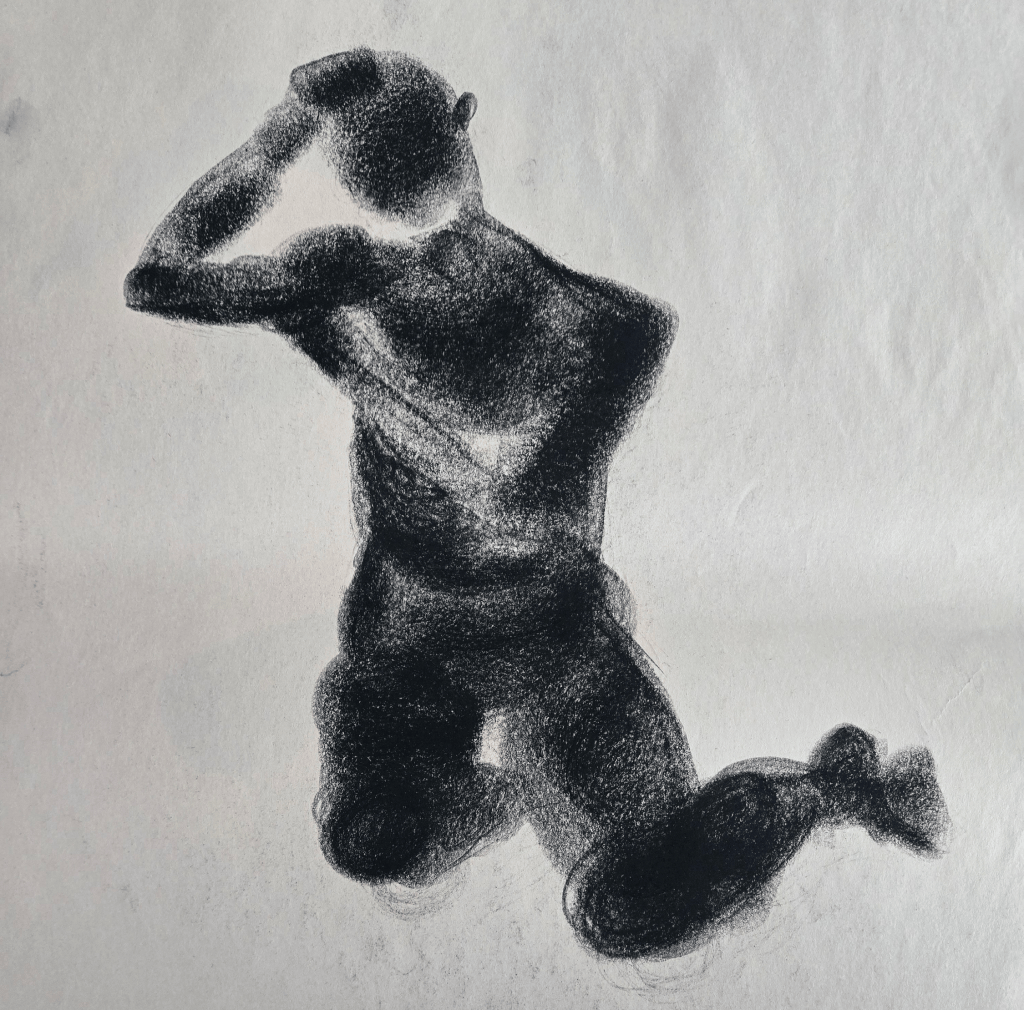
    A charcoal drawing of a figure kneeling and holding his head by Wendy Sinclair
    WS/2022