Tag: rest

  • The Body Knew First

    For a long time, I thought good decisions came from thinking harder.

    Gather more information. Analyze the situation. Consider every angle. Wait for certainty.

    Looking back, I noticed something unsettling.

    My body often knew long before I was willing to admit it.

    A tightening jaw, a held breath, an unease I couldn’t explain, a quiet no.

    For years, I had a simple explanation for these reactions.

    Anxiety.

    That explanation was convenient because it kept the focus on me. If the feeling was anxiety, then the problem was my interpretation, my fear, my sensitivity, my wounds.

    I didn’t have to ask whether the feeling might be responding to something real.

    What I rarely considered was that my body might be witnessing something my conscious mind was not yet ready to admit.

    Again and again, I treated these signals as obstacles to overcome rather than information to consider.

    I trusted explanations more than sensations, stories more than signals, and hope more than reality.

    I assumed the signal was a cue to gather more data. To wait, investigate further, withhold judgment until more evidence arrived.

    Sometimes that is wise.

    But looking back, I can see that I often misunderstood the nature of the signal itself. The signal was not pointing toward the data. The signal was the data.

    The tightening fist. The shifting in my balance. The sense of alarm. The difficult no.

    These were not distractions from reality. They were reality arriving through a different channel.

    Not conclusions, nor certainty. But rather, information. And information I repeatedly ignored.

    Part of the work of Secret Places became learning to stop arguing with those signals.

    Not because the body is God, not because every feeling is true, and not because intuition is infallible.

    But because my body had been recording reality long before I had language for what it was witnessing.

    The body was not the authority. But it was a witness.

    And often it arrived first.

    Many of the things I eventually admitted intellectually had already been registered physically.

    My body knew before I did.

    Listening wasn’t the hard part. The hard part was obeying.


    What truth might your body already know?
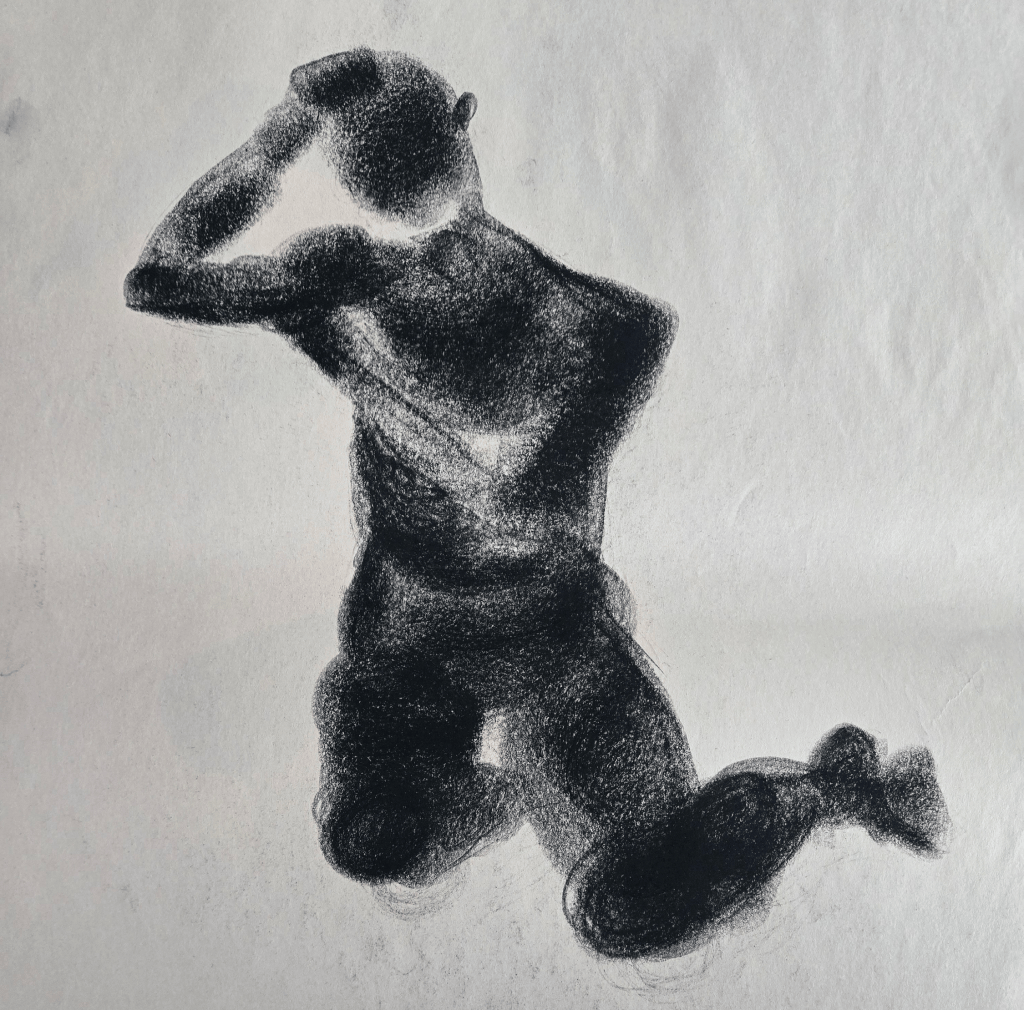
    A charcoal drawing of a figure kneeling and holding his head by Wendy Sinclair
    WS/2022
  • The Places Are Not Secret Because They Are Hidden

    “But when you pray, go into your room, close the door and pray to your Father, who is unseen. Then your Father, who sees what is done in secret, will reward you.”
    — Matthew 6:6

    This was one of the first passages of Scripture I spent time with after becoming an apprentice of Jesus.

    At first, I understood it literally. I thought the secret place was a location.

    A room with a closed door. A private place to pray. A quiet corner where nobody could see me.

    I looked around my condo and wondered where that place might be. A chair. The edge of my bed. The floor beside the window. Somewhere set apart from the rest of life.

    And I think that’s partly what Jesus meant.

    But over time, I discovered that the room was not the point.

    The relationship was.

    The secret place was not a room. It was a protected relationship with God. The room simply made that relationship easier to hear.

    The more time I spent there, the more I noticed that the relationship seemed to follow me. It appeared in my kitchen, on rooftops, in church pews, on the subway, beside lakes, on long walks, and in the quiet moments between ordinary responsibilities.

    The geography kept changing but the relationship remained.

    What surprised me most was that protecting this relationship came with costs. Not dramatic costs, but ordinary ones:

    Less performance.

    Less visibility.

    Less explaining.

    Less turning every meaningful experience into something public.

    Some things stopped becoming content, and moments stopped becoming stories. My experiences were allowed to remain between God and me.

    At first that felt like loss. Then it began to feel like freedom.

    Because the reward turned out not to be recognition, certainty, productivity, or even insight.

    The reward was the relationship itself.

    A quieter nervous system and a sweeter, slower pace.

    The miracle was the feeling of being less divided. The growing sense that I no longer needed to have a witness in order for something to be real.

    The places were never secret because they were hidden.

    They were secret because they were protected.


    What in your life deserves protection?

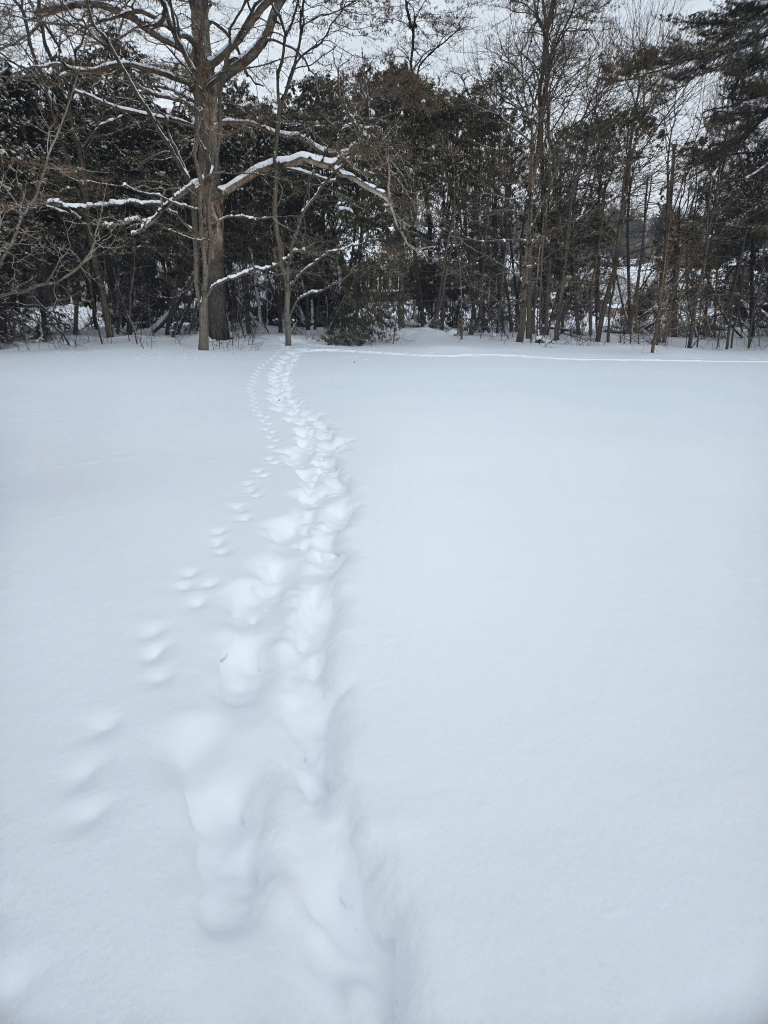
    A photo of footprints in the snow leading to the trees.
  • The February Silent Retreat

    There was nothing to fix.
    That’s the first thing that became clear.

    Not because everything in my life is perfect, but because the moment I removed the noise, there was nothing inside me that needed managing. No urgency, no pressure, no demand to become something else.

    Just space.

    Time changed first. Or maybe it disappeared. There was no clock, no watch, no anticipation. My body knew when to eat. Light told me it was morning. The dishes told me it was lunch. The day unfolded without asking anything from me.

    I wasn’t trying to get anywhere.

    Mary Oliver writes about “the lovely meaninglessness of time,” and I understood it immediately. Not as an idea, but as a condition. Time didn’t need to mean anything. It didn’t need to produce anything. It was just something I was inside of.

    And inside that, something else became obvious.

    I am sound just as I am.

    That line sounds simple, but it didn’t come from affirmation. It came from the absence of everything that usually interrupts it. No music, no input, no conversation, no devices, no performance. Without those, there was nothing left to argue with.

    There was no gap to close.

    The quiet didn’t make me better. It revealed what was already there when I stopped interfering.

    The biggest shift wasn’t emotional. It was structural.

    I stopped asking, “What should I do with this day?” and started noticing that the day didn’t require anything from me at all. I could sit. I could walk. I could write. I could do nothing.

    There was no prize for doing more.
    There was no consequence for doing less.

    There was just life, happening at the pace it actually happens.

    At some point, I realized how much of my normal life is built around unnecessary intensity. Not crisis, not chaos in the obvious sense, but a constant low-grade pressure to move, respond, produce, optimize.

    And I don’t want that anymore.

    It’s not necessary.
    It’s noise.

    When the noise drops, something else becomes audible. Not louder, just clearer. Signal doesn’t need to fight for attention. It’s already there.

    And underneath all of it, something even simpler:

    I am home.

    Not in a place. Not in a future version of my life. Just here.

    Mary Oliver writes, “Whenever I get home… somebody loves me there.”

    That’s what this felt like.

    Not something I created. Something I finally stopped interrupting.


    What might become audible if the noise were allowed to leave?

    The sitting room at Loretto Maryholme Retreat centre, wicker chairs and window showing the lake and sunset at dusk