“Oh my goodness!”
We usually hear it as an expression of surprise.
One day I found myself hearing it differently.
Not as an exclamation. As a recognition.
My goodness.
Not my achievements. Not my personality. Not my reputation.
My goodness.
The possibility that goodness is not something we manufacture, but something we uncover.
We use the word goodness all the time.
Goodness gracious.
A good person.
A good life.
The word slips easily into conversation, yet we rarely stop to ask what it means.
Not useful.
Not successful.
Not authentic.
Good.
In springtime of this year I attended a silent writing retreat.
The facilitator wasn’t remarkable because she was entertaining or unusually gifted. She didn’t offer a revolutionary idea or a clever framework that I rushed to participate in.
What stayed with me was something much quieter.
She seemed good.
Not in the thin sense of being polite, nice, or agreeable.
There was a coherence to her.
The music she chose.
The stories she told.
The pace of the retreat.
The way she listened.
The way she spoke.
Nothing felt manufactured. Nothing competed for attention. Her life seemed ordered around something I couldn’t quite name.
I left the retreat thinking less about what she had taught than about what I had witnessed.
It raised a question that has stayed with me ever since.
What is genuinely good?
Not what is fashionable. Not what is efficient. Not what is biblical or holy. Not what makes me feel important. Not even what I happen to want.
What is genuinely good?
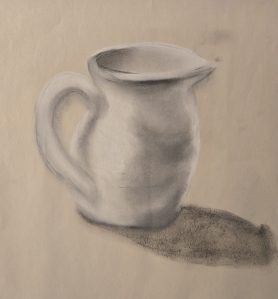
During one exercise she invited us to imagine ourselves as a water jug.
The invitation was simple.
Empty it.
The image has stayed with me.
Not because it was psychologically insightful, but because it stands in direct opposition to the story most of us have absorbed about change.
We imagine that growth comes through accumulation.
Read another book, learn another skill, strengthen another habit, collect another insight.
Become more.
The jug suggests something different.
Perhaps what matters most is not what we add, but what we remove.
That same idea appears in another image often attributed to Michelangelo.
The sculpture already exists within the marble.
The sculptor does not create it by addition.
He reveals it by removing everything that does not belong.
The jug and the marble tell the same story.
Goodness is revealed by subtraction, not by addition.
That is a very different vision of formation.
It suggests that goodness is not manufactured through self-improvement. It is uncovered as the things that obscure it are gradually removed.
Noise.
Fantasy.
Resentment.
Performance.
The need to use words to explain ourselves.
The endless pull of distraction.
Not because these things are the whole of who we are, but because they crowd out what is quieter, steadier, and more true.
Once I began thinking this way, another realization followed.
Every life is already organized around something.
Some lives are organized around achievement.
Others around romance.
Others around comfort, security, recognition, or pleasure.
None of these choices happen all at once.
They are built gradually through ordinary decisions.
The books we read.
The conversations we linger in.
The music we replay.
The people we admire.
The way we spend a Saturday afternoon.
Over time they form an architecture.
We often think of morality as a list of rules.
I have begun to think of it as architecture instead.
Every repeated choice places another stone.
Every habit reinforces a structure.
Every form of attention shapes the kind of person we are becoming.
The question is not whether a life has a moral architecture.
Every life does.
The question is what that architecture has been built around.
That question has become one of the central questions of this residency.
Not, What do I want?
Wants matter, but they are easily shaped by fear, exhaustion, loneliness, culture, and habit.
Plus, our desires change, don’t they? Often.
So instead, a deeper question remains.
What is genuinely good?
And once goodness is recognized, another question follows naturally.
How should a life be ordered around it?
Perhaps that is what obedience really is.
Not the relentless addition of more disciplines, more knowledge, or more effort.
The patient work of removing whatever obscures goodness, and then building an ordinary life around what remains.
Look carefully. What is already shaping the architecture of your life?


Leave a Reply